A rose scent can be created from natural Rose Oil, laboratory-made aroma molecules, or a blend of both. All three can smell beautiful, but the source of the ingredients, batch consistency, price, and wearing experience may differ.
Many people assume that Natural automatically means safe and high-quality, while Synthetic means fake or harmful. In reality, the quality of an attar depends on its ingredients, formula, concentration, raw materials, and the skill of the maker.
The quality of the formula and your personal preference matter more than whether an attar is labelled Natural or Synthetic.
What Is Natural Attar?
Natural Attar uses aromatic materials obtained from natural sources such as flowers, woods, roots, leaves, resins, spices, and citrus peels. These materials are collected through methods such as distillation or extraction.
Traditionally, Indian attar was made by slowly distilling botanical materials and capturing their aroma in an oil base such as Sandalwood Oil. However, the term Natural Attar is not always used consistently in the market. It is important to check the product description for the source of the ingredients and the production method.
What Is Synthetic Attar?
Synthetic Attar uses aroma chemicals created in a laboratory. Some molecules resemble scents found in nature, while others can produce scent profiles that cannot be extracted directly from a flower, fruit, or wood.
Synthetic does not automatically mean fake or low-quality. It allows perfumers to create consistent formulas, explore new scent profiles, and reduce dependence on rare natural materials.
To understand how attar differs from spray perfume, read AROWA’s Attar vs Perfume guide.
Main Differences Between Natural and Synthetic Attar
Factor | Natural Attar | Synthetic Attar |
|---|---|---|
Source | Flowers, woods, roots, resins, and other natural sources | Aroma molecules created in a laboratory |
Scent | May vary slightly depending on the raw material and harvest | Usually more consistent when the same formula is followed |
Availability | Can depend on season, region, and harvest | Supply is generally more predictable |
Price | May cost more because of low yield and sourcing expenses | Can be more affordable when produced at scale |
Creative range | Depends on aromatic materials found in nature | Can recreate familiar scents or produce entirely new ones |
Allergy risk | Natural ingredients may also contain allergens | Synthetic ingredients may also cause sensitivity |
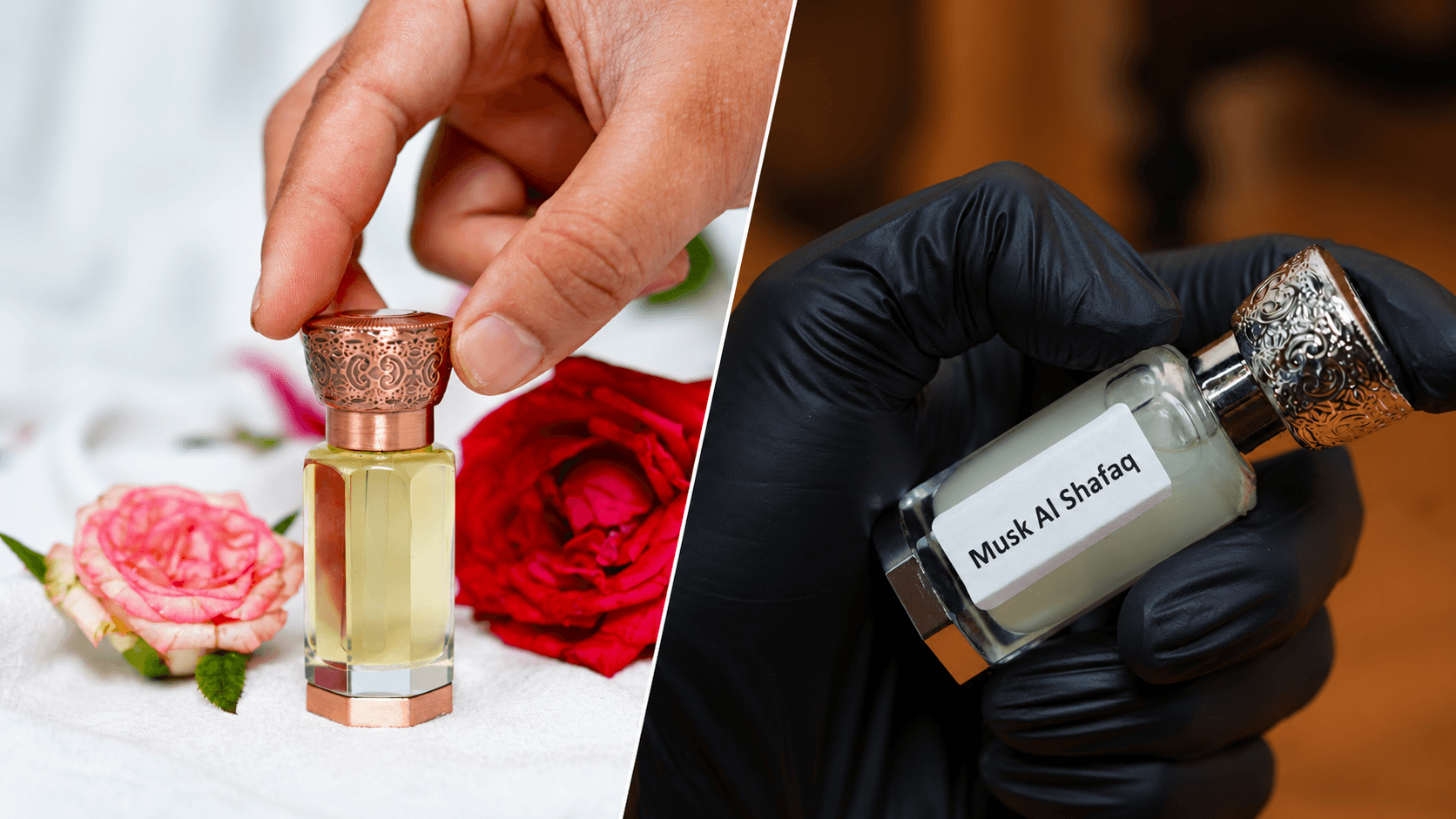
[Place a comparison image of AROWA Ruh Gulab and Musk Al Shafaq bottles here]
Alt text: AROWA Natural Ruh Gulab and Synthetic Musk Al Shafaq attar bottles
AROWA Natural Ruh Gulab and Synthetic Musk Al Shafaq.
How Do Scent, Longevity, and Price Differ?
Natural materials usually contain many aromatic components. Rose Oil, Oud, and Vetiver may therefore reveal several subtle facets. Their character may also vary slightly between batches because of weather, harvest conditions, and extraction methods.
Synthetic materials can highlight a specific note or create an entirely new accord. However, Natural is not always complex, and Synthetic is not always flat. A skilled perfumer can create a layered fragrance with either type of material.
To understand how a fragrance changes over time, read AROWA’s guide to fragrance notes.
Neither category is automatically more long-lasting. Longevity depends on the formula, concentration, volatility of the ingredients, base, skin chemistry, weather, and application.
Similarly, not every Natural Attar is expensive, and not every Synthetic Attar is cheap. Rare raw materials can increase the price of Natural Attar, while research, purification, and high-grade aroma molecules can also make a synthetic formula expensive.
Is Natural Attar Safer and More Sustainable?
The word Natural does not guarantee safety. Fragrance ingredients may cause an allergic reaction in some people. Both natural essential oils and synthetic aroma molecules can cause sensitivity.
Test a new attar on a small area of skin first. Stop using it if you notice irritation, itching, or discomfort. Seek medical advice if you have a known fragrance allergy.
There is no single answer for sustainability either. Natural ingredients can be renewable, but overharvesting, low yield, and high land or water use may place pressure on the environment.
Synthetic alternatives may reduce demand for rare plants or animal-derived materials, but laboratory production also has an environmental footprint. The source, traceability, and manufacturing process should therefore be considered.
What Is Hybrid Attar?
Many modern attars combine natural and synthetic ingredients. A Hybrid formula can pair the depth of natural materials with the consistency and creative range of synthetic ingredients.
For example, a complementary synthetic molecule may be used to enhance the character of Natural Rose. A Hybrid formula is not automatically inferior. When carefully composed, it can offer the advantages of both types of materials.
Natural and Synthetic Attar Examples at AROWA
AROWA’s Ruh Gulab is an example of a Natural Attar. According to its product description, its aromatic material is produced from Rosa Damascena using a traditional hydro-distillation method. It may appeal to those who appreciate the variation and traditional character of natural rose.
Musk Al Shafaq is an example of a high-grade Synthetic Attar. Its warm, spicy, and musky profile shows that a well-made synthetic composition can also feel refined and layered.
Which Type Is Better for You?
Choose Natural Attar if botanical materials, traditional extraction, and subtle batch variation are important to you.
Choose Synthetic Attar if you prefer a consistent scent profile, modern fragrance styles, and a wider price range.
Choose Hybrid Attar if you want the benefits of natural and synthetic ingredients in one formula.
Before buying, read the product description and test a sample on your skin when possible. Notice how the fragrance develops from the opening to the dry-down. You can also read AROWA’s guide on how to choose a good attar.
Frequently Asked Questions
Is Natural Attar chemical-free?
No. Everything in nature is also made of chemicals. Natural refers to the source of the aromatic material.
Is Synthetic Attar fake?
No. Synthetic Attar uses laboratory-made aroma ingredients. A counterfeit product and a synthetic composition are not the same thing.
Does Synthetic Attar always last longer?
No. Longevity depends on the complete formula, concentration, skin chemistry, weather, and application.
Final Thoughts
The main differences between Natural and Synthetic Attar are the source of the ingredients, production method, consistency, availability, and creative possibilities.
There is no need to treat one as good and the other as bad. Consider your preferences, budget, sensitivity, and the occasion. A good attar is one with a well-made formula and a scent that you genuinely enjoy.