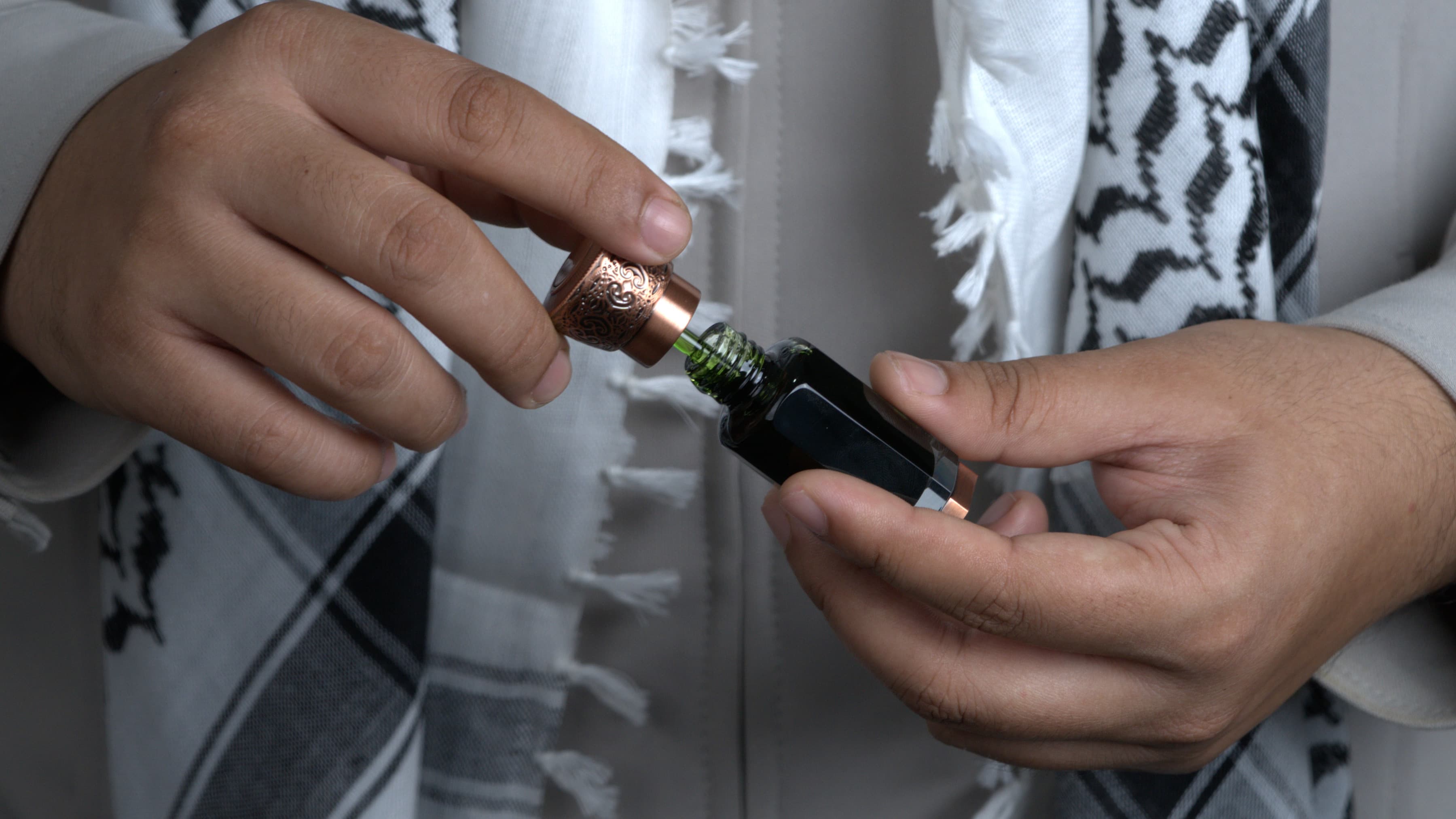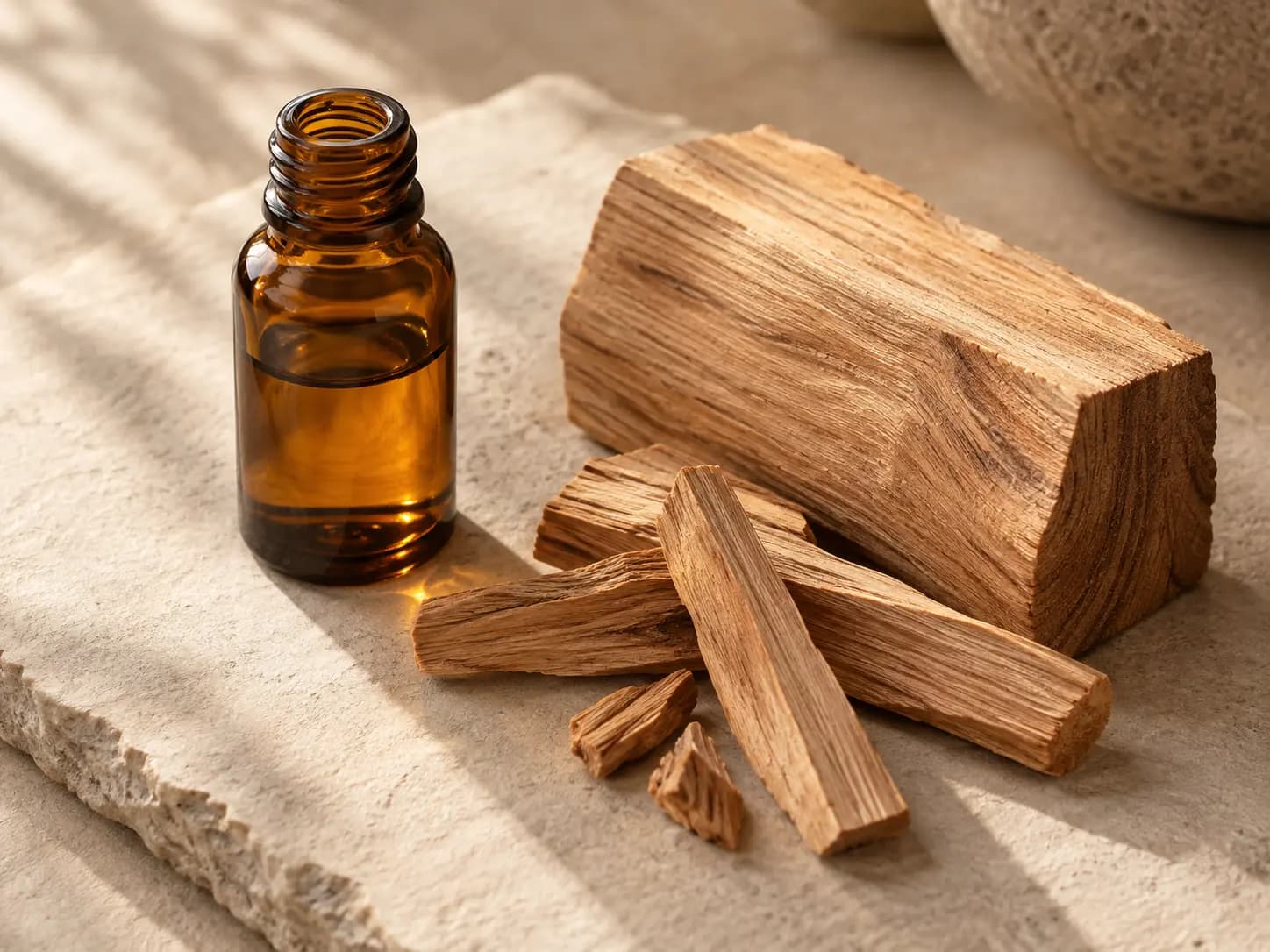
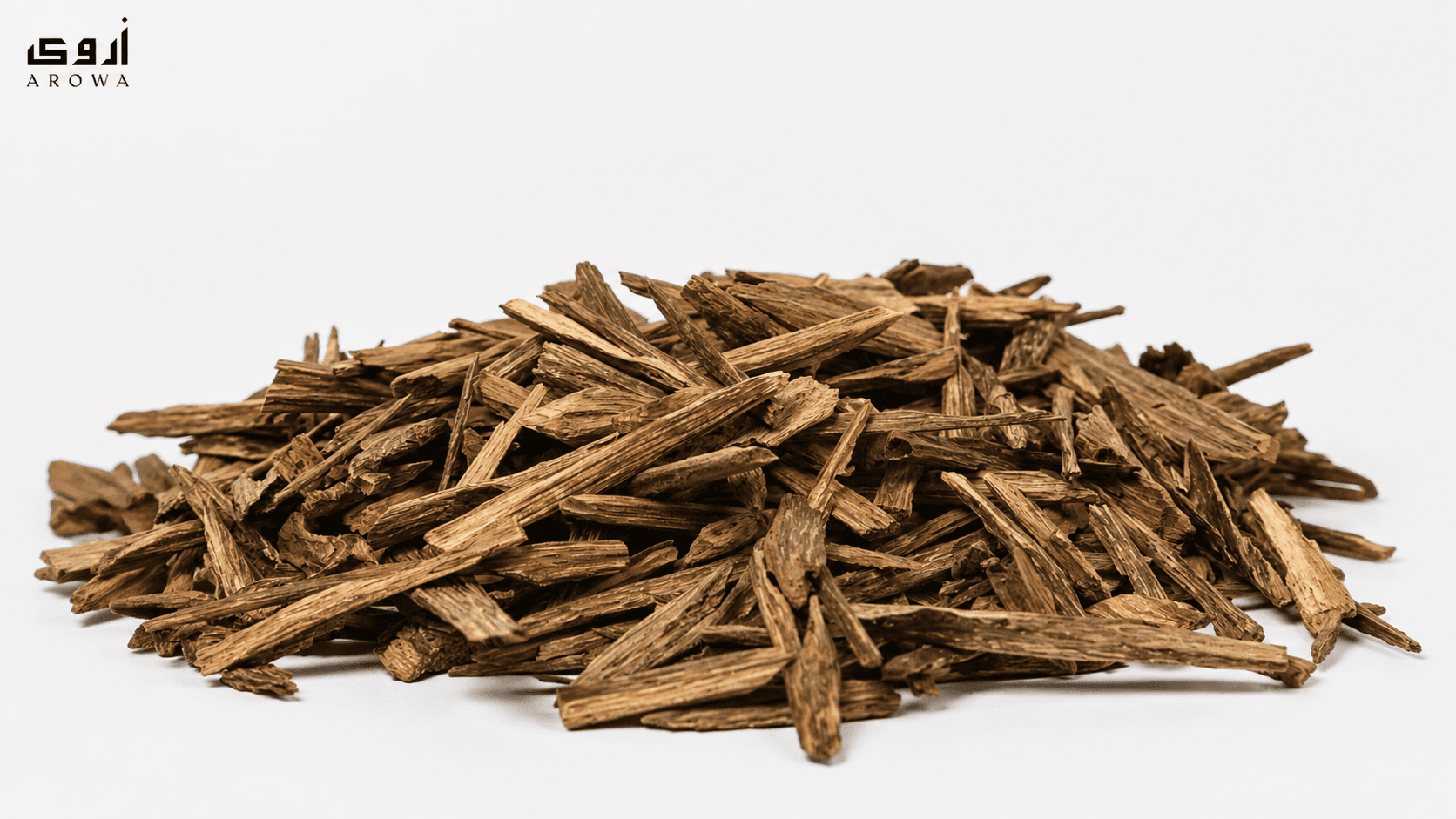
Oud is a rich, resinous aromatic oil derived from Agarwood. When an Aquilaria tree is injured or infected, it produces a dark resin within the wood as a natural defense. The resin-rich wood is then distilled to extract the oil known as Oud. In Arabic, it is called Dehn Al Oud.
What Exactly Is Oud?
The word Oud comes from the Arabic word “عود” (ʿūd), which means wood. You may also see it written as Oudh. The oil distilled from Agarwood is known in Arabic as Dehn Al Oud, meaning Agarwood oil.
Oud comes mainly from Aquilaria trees found across South and Southeast Asia, including Bangladesh, India, Vietnam, and Indonesia. But an Aquilaria tree does not automatically contain Agarwood.
Healthy wood is usually pale, light, and fairly mild in smell. The real change begins when part of the tree is damaged. Insects, storms, infection, or other injuries can trigger the tree to produce resin around the affected area.
The process can also be encouraged by making controlled wounds in the tree. In some cases, microorganisms or fungal materials are introduced to help stimulate resin formation. Even then, every tree responds differently. Some develop more resin, some less, and some never produce the quality of Agarwood people are looking for.
That is part of what makes good Agarwood so valuable.
Agarwood and Oud are not exactly the same thing.
Agarwood is the resin-rich aromatic wood. Oud Oil is the concentrated aromatic oil distilled from that wood.
What Does Oud Smell Like?
Oud usually opens with a deep woody presence, but that is only one part of the experience.
Depending on the wood and how the oil was produced, you may notice smoke, damp earth, resin, dry wood, leather, or a subtle sweetness. One Oud may remind you of old wood giving off warm smoke. Another may feel closer to wet soil, dry hay, or the earthy smell of a forest after rain.
This is one reason Oud is difficult to describe with a single word.
Woody: Deep, warm wood
Smoky: Warm, aromatic smoke
Earthy: Damp soil or a forest-like character
Resinous: Rich, warm resin
Leathery: Aged, dry leather
Animalic: A raw, intense musky character found in some Natural Ouds
What Do Animalic and Leathery Mean?
The word animalic can sound unusual if you are new to Oud. It does not literally mean the scent smells like an animal.
Some Natural Ouds have a raw, warm, slightly wild character that may remind people of dry hay, old stables, damp soil, or other organic smells. This side can be more noticeable in certain Indian Ouds.
Leathery feels different. Think of aged, dry leather rather than the sharp smell of a brand-new leather bag. Mixed with wood and resin, it can give the scent a darker and more mature feel.
Not every Oud has these qualities. The species of tree, where it was grown, the amount and age of the resin, and the distillation method can all affect the final smell.
Cambodian Oud, for example, may lean softer and sweeter, while some Indian Ouds can feel darker and more animalic. These are tendencies rather than fixed rules. Two Ouds from the same region can still smell very different.
Oud Changes With Time
Natural Oud rarely reveals its whole character in the first smell.
The opening may feel sharp, smoky, earthy, or woody. Give it some time and those stronger edges can soften, allowing sweeter resin, leathery, woody, or balsamic notes to come through.
An Oud that feels intense during the first ten minutes may become much smoother an hour or two later.
Your skin matters too. Body warmth and individual skin chemistry can change how the scent develops, which is why the same Oud may smell slightly different from one person to another.
Why Is Oud So Expensive?
Much of Oud's value comes down to two things: rarity and time.
Not every Aquilaria tree develops the same amount of resin, and resin formation alone does not guarantee high-quality Agarwood. Good resin needs time to build and spread through the wood.
That process can take years.
Why Are Harvesting and Distillation So Difficult?
Finding good Agarwood is only the beginning.
The resin-rich sections need to be carefully separated from ordinary wood. This takes experience because valuable material can easily be wasted.
Then comes distillation. Selected Agarwood is prepared and distilled over a long period, yet the amount of Oud Oil produced can still be surprisingly small.
So from selecting the wood to collecting the final oil, the whole process is slow, careful, and labor-intensive.
How Does Grade Affect the Price?
Not all Agarwood has the same quality.
Some pieces contain relatively little resin. Others are much darker, heavier, and more aromatic because resin has built up more densely inside the wood.
In the market, sellers often use different Grades based on factors such as resin content, density, age, and aroma. Names like AA Double Super and AAA Triple Super are used in some markets.
However, these names should not be treated as one universal international grading system. Agarwood grading can vary between regions, suppliers, and markets.
Why Does Origin Affect the Price?
Where the Agarwood comes from can also influence its value.
Agarwood from Bangladesh, India, Cambodia, Vietnam, Malaysia, or Indonesia may differ in aroma, resin content, age, availability, and overall quality.
In some regions, old Natural resin-rich wood has become very difficult to find. In others, cultivated Agarwood is more widely available.
Rare origin, older wood, and heavier resin concentration usually push the price higher.
How Do Rarity and Demand Affect the Price?
Oud has been valued for generations across the Middle East and Asia. Today, it also has a strong place in luxury and niche perfumery.
But high-quality resin-rich Agarwood remains limited, and producing it takes time.
So even when demand grows, the supply of good Natural Oud does not increase quickly. That imbalance is one of the main reasons prices can become so high.
Natural Oud vs Synthetic Oud
Natural Oud: Comes directly from resin-rich Agarwood. The wood is distilled to produce a small amount of concentrated aromatic oil. That oil is Natural Oud, also known as Dehn Al Oud.
Synthetic Oud: Instead of relying entirely on Agarwood Oil, perfumers combine aroma chemicals and other fragrance materials to recreate or interpret the familiar character of Oud.
The difference is not simply that one is good and the other is bad.
Natural Oud can vary depending on the origin of the wood, resin quality, age, and distillation method. Synthetic Oud can be produced in a more controlled way, making it easier to keep the scent similar from one batch to another.
There is also a practical reason Synthetic Oud is widely used in commercial perfume. Natural Oud is expensive, limited, and naturally variable. Synthetic materials make it easier to produce Oud-style fragrances at a larger scale while keeping the scent more consistent.
A perfume having “Oud” on the label does not automatically mean it contains Natural Oud.
How Can You Judge the Quality and Authenticity of Agarwood?
There is no single home test that can reliably prove whether a piece of Agarwood is genuine.
Dark resin lines, density, weight, and the overall appearance of the wood can offer some clues. The traditional water test is also sometimes used to judge density and resin content.
Agarwood sinking in water does not automatically prove that it is genuine or high quality.
The same applies when the wood is burned. An experienced person may look at the way the resin reacts, the smoke, and the aroma, but none of these should be treated as a perfect authenticity test on their own.
For stronger verification, examining the structure and chemical composition of the wood is more reliable.
Oud Oil can be even harder to judge at home. In that case, where it came from, how it was produced, how transparent the seller is, and whether expert or laboratory verification is available matter much more.
Why Does Oud Last So Long?
Oud often sits in the base of an attar or perfume.
Lighter notes may appear first, while the deeper Oud character remains later in the scent. This is why many Oud-based fragrances still feel rich well into the Dry-down.
Oud can also work as a Fixative, helping give the base of a fragrance more depth and staying power as lighter materials fade.
Both Natural and Synthetic Oud can last a long time. But Longevity cannot be judged simply by whether an Oud is natural or synthetic.
The quality of the materials, concentration, and the overall formula all play a part.
Simply having “Oud” in the name does not mean every fragrance will have the same Longevity.
The History of Oud
The story of Oud began long before modern perfume.
Agarwood was burned for its aromatic smoke across parts of Asia centuries ago. Historical records also describe Agarwood being traded from areas such as Vietnam to China and Japan, where it became valued in religious practice, meditation, and incense culture.
China and Japan developed their own traditions around the wood. Agarwood was used in Buddhist practices, including the making of prayer beads.
In Japan, Kōdō developed as a refined practice of appreciating aromatic woods, including Agarwood.
In the Middle East, Agarwood became closely connected with everyday fragrance culture. Its smoke has traditionally been used to scent homes, clothing, and the body, as well as during hospitality and religious occasions.
Later, distilled Dehn Al Oud became highly valued as a personal fragrance.
Western perfumery embraced Oud much later. From the 2000s onward, luxury and niche perfume houses began featuring it more prominently. Fragrances such as Tom Ford Oud Wood helped make the name Oud familiar to a much wider audience.
Sylhet's Long Tradition of Agarwood and Attar
The story of Oud in Bangladesh is difficult to tell without mentioning Sylhet.
Barlekha in Moulvibazar, particularly the Sujanagar area, has been associated with Agar cultivation, Agarwood processing, and attar production for generations. Historical and local accounts describe the region's Agar-Attar tradition as being around 400 years old.
Here, Agar is more than a tree. For many families, it is connected to livelihood, craftsmanship, distillation skills, and knowledge passed down over generations.
In 2024, Moulvibazar Agar and Agar-Attar received Geographical Indication, or GI, recognition in Bangladesh.
That history gives Sylheti Agarwood a character beyond origin alone. It represents a long regional tradition of growing Agar trees, working with resin-rich wood, and producing attar through local experience.
Why Does CITES Matter in the Oud Trade?
The main Agarwood-producing genera, Aquilaria and Gyrinops, are covered under CITES Appendix II for international trade.
This does not mean international trade in Agarwood or Oud is completely banned.
Instead, the rules are designed to help make sure trade is legal and does not put unsustainable pressure on wild populations.
For anyone buying or selling Agarwood, wood chips, or Oud Oil internationally, knowing the source of the material and understanding the required documentation is important.
Why Doesn't Everyone Like Oud?
Oud has a distinctive personality, and not everyone falls in love with it immediately.
Some Natural Ouds have animalic or barnyard-like qualities that may feel raw or unfamiliar at first. If you have never smelled anything similar, the opening can seem strong, heavy, or even strange.
Familiarity matters too.
In many Middle Eastern homes, Agarwood smoke and Oud fragrances are part of everyday life. Someone experiencing the same scent for the first time may react very differently.
Skin also changes the experience. One person may bring out the warm woody side beautifully, while another may notice something sharper, sourer, or slightly medicinal.
That does not necessarily mean the Oud is bad. It simply means Oud can behave differently from person to person.
How Should You Use Oud?
Amount: If you are trying Oud for the first time, start with a very small amount. Pure or concentrated Oud Oil may need only a tiny application on one or two areas.
Where to apply: Try warm areas such as the wrists, behind the ears, the sides of the neck, or the inner elbows.
Give it time: Do not judge Oud immediately after applying it. The opening can feel intense before the scent begins to soften and develop.
Do not rub: Avoid rubbing your wrists together after applying Oud.
Skin safety: Avoid the eye area and broken or irritated skin. When trying a new Oud, test a small amount on a small area of skin first.
Clothing: Be careful with darker Oud Oils, as some may leave marks on fabric.
Layering: Oud can pair beautifully with Rose, Amber, Sandalwood, Vanilla, or Saffron.
When to wear it: Darker Oud fragrances often work especially well in the evening, during special occasions, or in cooler weather. Softer Oud blends can be easier to wear during the day or as part of a regular routine.
Oud is difficult to understand from a single smell. Its origin, the quality of the Agarwood, how the resin developed, and the way the oil was distilled all shape the final experience.
That combination of rarity, history, craftsmanship, and variation is what has kept Oud valuable for generations.
AROWA Oud Collection
AROWA's Oud Collection includes pure Oud Oils and selected Oud Wood, each with a different scent profile and way of use.
Dehn Al Oud Sylheti ↗
A pure Oud Oil distilled from Sylheti Agarwood.
We personally inspect the Agarwood and evaluate its aroma and quality before sourcing it. The opening has a deep woody feel with a lightly animalic edge. As it develops, leather, resin, and warm smoky notes become more noticeable.
It is well suited to people who enjoy the changing layers of Natural Oud.
Dehn Al Oud Suyufi ↗
Dehn Al Oud Suyufi is suited to those who enjoy deep Indian Oud but still want some sweetness and refinement.
Made from mature Indian Agarwood, this pure Oud Oil opens with smoky and woody notes alongside a soft touch of rose. As it develops, leather and a light citrus note become clearer.
In the Dry-down, Labdanum, Musk, and Amber leave a warm, mature finish.
Sylheti Agarwood, AA Double Super ↗
Selected Sylheti Agarwood sold under the AA Double Super Grade.
When burned, it gives off a deep smoky and resinous aroma that gradually softens and leaves behind a subtle sweetness.
It is a good choice for people who enjoy burning Oud Wood at home and letting the scent develop slowly.
Sylheti Agarwood, AAA Triple Super ↗
A higher market Grade of selected Sylheti Agarwood.
Its heavier resin presence gives the smoke a denser and deeper aroma when burned. It is better suited to those looking for a richer resin character and a more lingering aromatic experience.
Frequently Asked Questions About Oud
Are Oud and Agarwood the Same Thing?
Not exactly. Agarwood is the resin-rich aromatic wood. Oud Oil, or Dehn Al Oud, is the concentrated aromatic oil distilled from that wood.
Does Genuine Agarwood Have to Sink in Water?
No. Sinking can give some indication of density and resin content, but it should not be treated as proof of authenticity on its own.
Is Natural Oud Always Better Than Synthetic Oud?
Not necessarily. They are made differently and serve different purposes. Which one suits you better depends on the fragrance, how you plan to use it, and your personal preference.
How Much Oud Should a Beginner Use?
Start with a very small amount. With concentrated Oud Oil, a tiny application on one or two areas may already be enough.
Why Can Oud Prices Vary So Much?
Price can change depending on resin content, origin, age, Grade, distillation method, availability, and the overall quality of the raw material.
What Makes Sylheti Agarwood Special?
Sylhet has a long tradition of Agar cultivation and attar production. Moulvibazar Agar and Agar-Attar also received GI recognition in Bangladesh in 2024.